
diff options
| author | Nicolas Vasilache <ntv@google.com> | 2020-01-03 13:05:44 -0500 |
|---|---|---|
| committer | Nicolas Vasilache <ntv@google.com> | 2020-01-03 13:14:24 -0500 |
| commit | a932f033a349e8a1c5eedba6e7ed23bd9527355d (patch) | |
| tree | 38743a2b2e35a1644f2c01bfbd0ac0dde73d60f1 /mlir/docs/Dialects | |
| parent | c75aac42a635bf710e818487592ea3bc5d7ef9b1 (diff) | |
| download | bcm5719-llvm-a932f033a349e8a1c5eedba6e7ed23bd9527355d.tar.gz bcm5719-llvm-a932f033a349e8a1c5eedba6e7ed23bd9527355d.zip | |
[mlir][Vector] NFC - Add documentation for the VectorOps dialect.
Diffstat (limited to 'mlir/docs/Dialects')
| -rw-r--r-- | mlir/docs/Dialects/Vector.md | 493 |
1 files changed, 486 insertions, 7 deletions
diff --git a/mlir/docs/Dialects/Vector.md b/mlir/docs/Dialects/Vector.md index 04f5ba71cdb..79f7d6d7a1e 100644 --- a/mlir/docs/Dialects/Vector.md +++ b/mlir/docs/Dialects/Vector.md @@ -1,14 +1,493 @@ # Vector Dialect -This dialect provides mid-level abstraction for the MLIR super-vectorizer. +MLIR supports multi-dimensional `vector` types and custom operations on those +types. A generic, retargetable, higher-order ``vector`` type (`n-D` with `n > +1`) is a structured type, that carries semantic information useful for +transformations. This document discusses retargetable abstractions that exist +in MLIR today and operate on ssa-values of type `vector` along with pattern +rewrites and lowerings that enable targeting specific instructions on concrete +targets. These abstractions serve to separate concerns between operations on +`memref` (a.k.a buffers) and operations on ``vector`` values. This is not a +new proposal but rather a textual documentation of existing MLIR components +along with a rationale. -[TOC] +# Positioning in the Codegen Infrastructure +The following diagram, recently presented with the [StructuredOps +abstractions](https://drive.google.com/corp/drive/u/0/folders/1sRAsgsd8Bvpm_IxREmZf2agsGU2KvrK-), +captures the current codegen paths implemented in MLIR in the various existing +lowering paths. +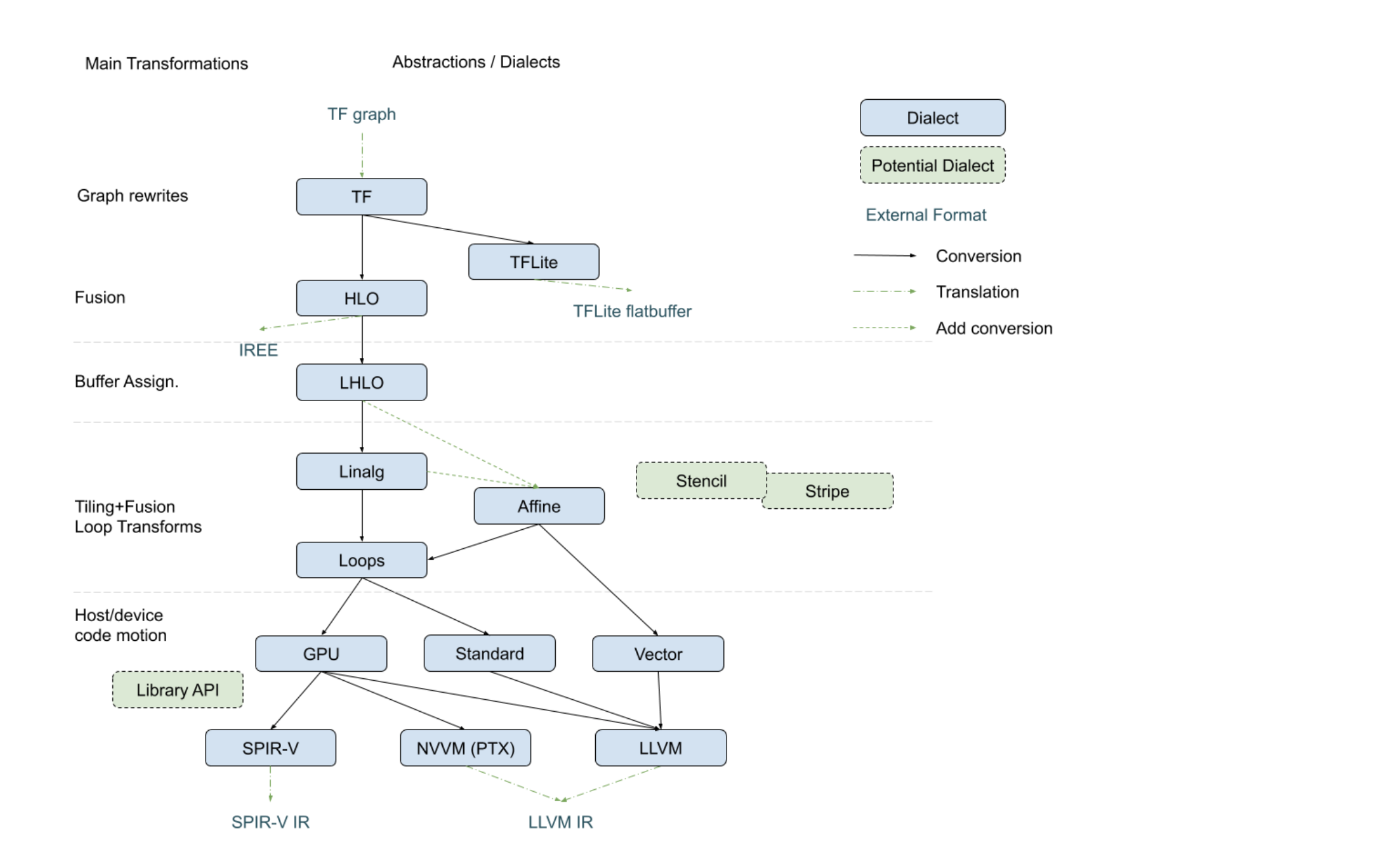 -## Operations +The following diagram seeks to isolate `vector` dialects from the complexity +of the codegen paths and focus on the payload-carrying ops that operate on std +and `vector` types. This diagram is not to be taken as set in stone and +representative of what exists today but rather illustrates the layering of +abstractions in MLIR. + +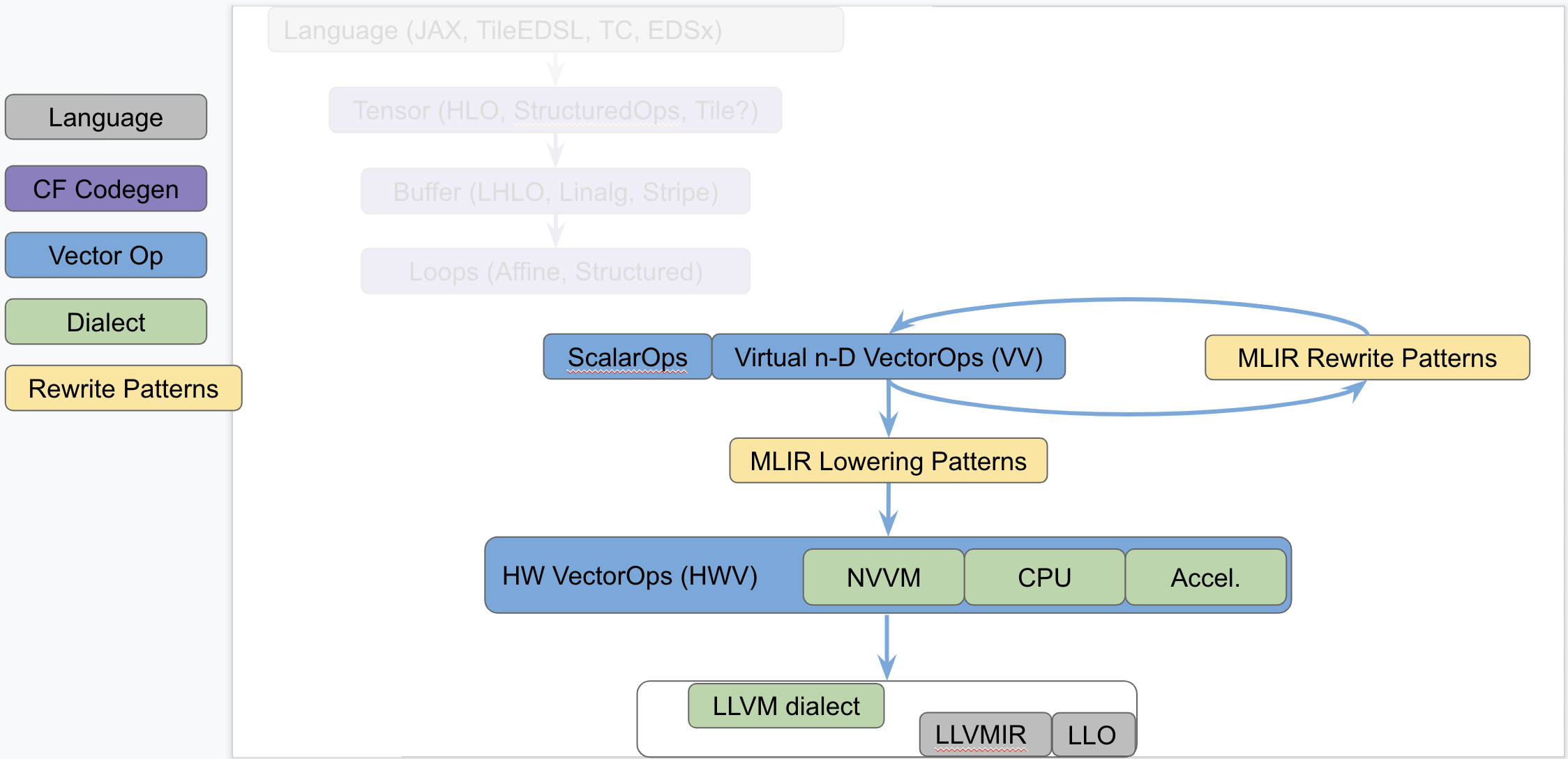 + +This separates concerns related to (a) defining efficient operations on +`vector` types from (b) program analyses + transformations on `memref`, loops +and other types of structured ops (be they `HLO`, `LHLO`, `Linalg` or other ). +Looking a bit forward in time, we can put a stake in the ground and venture +that the higher level of `vector`-level primitives we build and target from +codegen (or some user/language level), the simpler our task will be, the more +complex patterns can be expressed and the better performance will be. + +# Components of a Generic Retargetable Vector-Level Dialect +The existing MLIR `vector`-level dialects are related to the following +bottom-up abstractions: + +1. Representation in `LLVMIR` via data structures, instructions and +intrinsics. This is referred to as the `LLVM` level. +2. Set of machine-specific operations and types that are built to translate +almost 1-1 with the HW ISA. This is referred to as the Hardware Vector level; +a.k.a `HWV`. For instance, we have (a) a `NVVM` dialect (for `CUDA`) with +tensor core ops, (b) accelerator-specific dialects (internal), a potential +(future) `CPU` dialect to capture `LLVM` intrinsics more closely and other +dialects for specific hardware. Ideally this should be auto-generated as much +as possible from the `LLVM` level. +3. Set of virtual, machine-agnostic, operations that are informed by costs at +the `HWV`-level. This is referred to as the Virtual Vector level; a.k.a +`VV`. This is the level that higher-level abstractions (codegen, automatic +vectorization, potential vector language, ...) targets. + +The existing generic, retargetable, `vector`-level dialect is related to the +following top-down rewrites and conversions: + +1. MLIR Rewrite Patterns applied by the MLIR `PatternRewrite` infrastructure +to progressively lower to implementations that match closer and closer to the +`HWV`. Some patterns are "in-dialect" `VV -> VV` and some are conversions `VV +-> HWV`. +2. `Virtual Vector -> Hardware Vector` lowering is specified as a set of MLIR +lowering patterns that are specified manually for now. +3. `Hardware Vector -> LLVM` lowering is a mechanical process that is written +manually at the moment and that should be automated, following the `LLVM -> +Hardware Vector` ops generation as closely as possible. + +# Short Description of the Existing Infrastructure + +## LLVM level +On CPU, the `n-D` `vector` type currently lowers to +`!llvm<array<vector>>`. More concretely, `vector<4x8x128xf32>` lowers to +`!llvm<[4 x [ 8 x [ 128 x float ]]]>`. +There are tradeoffs involved related to how one can access subvectors and how +one uses `llvm.extractelement`, `llvm.insertelement` and +`llvm.shufflevector`. A [deeper dive section](#DeeperDive) discusses the +current lowering choices and tradeoffs. + +## Hardware Vector Ops +Hardware Vector Ops are implemented as one dialect per target. +For internal hardware, we are auto-generating the specific HW dialects. +For `GPU`, the `NVVM` dialect adds operations such as `mma.sync`, `shfl` and +tests. +For `CPU` things are somewhat in-flight because the abstraction is close to +`LLVMIR`. The jury is still out on whether a generic `CPU` dialect is +concretely needed, but it seems reasonable to have the same levels of +abstraction for all targets and perform cost-based lowering decisions in MLIR +even for `LLVM`. +Specialized `CPU` dialects that would capture specific features not well +captured by LLVM peephole optimizations of on different types that core MLIR +supports (e.g. Scalable Vectors) are welcome future extensions. + +## Virtual Vector Ops +Some existing Standard and VectorOps Dialect on `n-D` `vector` types comprise: +``` +%2 = std.addf %0, %1 : vector<3x7x8xf32> // -> vector<3x7x8xf32> +%2 = std.mulf %0, %1 : vector<3x7x8xf32> // -> vector<3x7x8xf32> +%2 = std.splat %1 : vector<3x7x8xf32> // -> vector<3x7x8xf32> + +%1 = vector.extract %0[1]: vector<3x7x8xf32> // -> vector<7x8xf32> +%1 = vector.extract %0[1, 5]: vector<3x7x8xf32> // -> vector<8xf32> +%2 = vector.outerproduct %0, %1: vector<4xf32>, vector<8xf32> // -> vector<4x8xf32> +%3 = vector.outerproduct %0, %1, %2: vector<4xf32>, vector<8xf32> // fma when adding %2 +%3 = vector.strided_slice %0 {offsets = [2, 2], sizes = [2, 2], strides = [1, 1]}: + vector<4x8x16xf32> // Returns a slice of type vector<2x2x16xf32> + +%2 = vector.transfer_read %A[%0, %1] + {permutation_map = (d0, d1) -> (d0)}: memref<7x?xf32>, vector<4xf32> + +vector.transfer_write %f1, %A[%i0, %i1, %i2, %i3] + {permutation_map = (d0, d1, d2, d3) -> (d3, d1, d0)} : + vector<5x4x3xf32>, memref<?x?x?x?xf32> +``` + +The list of VectorOps is currently undergoing evolutions and is best kept +track of by following the evolution of the +[VectorOps.td](https://github.com/tensorflow/mlir/blob/master/include/mlir/Dialect/VectorOps/VectorOps.td) +ODS file (markdown documentation is automatically generated locally when +building and populates the [Vector +doc](https://github.com/tensorflow/mlir/blob/master/g3doc/Dialects/Vector.md)). Recent +extensions are driven by concrete use cases of interest. A notable such use +case is the `vector.contract` op which applies principles of the StructuredOps +abstraction to `vector` types. + +## Virtual Vector Rewrite Patterns + +The following rewrite patterns exist at the `VV->VV` level: + +1. The now retired `MaterializeVector` pass used to legalize ops on a +coarse-grained virtual `vector` to a finer-grained virtual `vector` by +unrolling. This has been rewritten as a retargetable unroll-and-jam pattern on +`vector` ops and `vector` types. +2. The lowering of `vector_transfer` ops legalizes `vector` load/store ops to +permuted loops over scalar load/stores. This should evolve to loops over +`vector` load/stores + `mask` operations as they become available `vector` ops +at the `VV` level. + +The general direction is to add more Virtual Vector level ops and implement +more useful `VV -> VV` rewrites as composable patterns that the PatternRewrite +infrastructure can apply iteratively. + +## Virtual Vector to Hardware Vector Lowering +For now, `VV -> HWV` are specified in C++ (see for instance the +[SplatOpLowering for n-D +vectors](https://github.com/tensorflow/mlir/commit/0a0c4867c6a6fcb0a2f17ef26a791c1d551fe33d) +or the [VectorOuterProductOp +lowering](https://github.com/tensorflow/mlir/commit/957b1ca9680b4aacabb3a480fbc4ebd2506334b8)). + +Simple [conversion +tests](https://github.com/tensorflow/mlir/blob/master/test/Conversion/VectorToLLVM/vector-to-llvm.mlir) +are available for the `LLVM` target starting from the Virtual Vector Level. + +# Rationale +## Hardware as `vector` Machines of Minimum Granularity + +Higher-dimensional `vector`s are ubiquitous in modern HPC hardware. One way to +think about Generic Retargetable `vector`-Level Dialect is that it operates on +`vector` types that are a multiples of a "good" `vector` size so the HW can +efficiently implement a set of high-level primitives +(e.g. `vector<8x8x8x16xf32>` when HW `vector` size is say `vector<4x8xf32>`). + +Some notable `vector` sizes of interest include: + +1. CPU: `vector<HW_vector_size * k>`, `vector<core_count * k’ x +HW_vector_size * k>` and `vector<socket_count x core_count * k’ x +HW_vector_size * k>` +2. GPU: `vector<warp_size * k>`, `vector<warp_size * k x float4>` and +`vector<warp_size * k x 4 x 4 x 4>` for tensor_core sizes, +3. Other accelerators: n-D `vector` as first-class citizens in the HW. + +Depending on the target, ops on sizes that are not multiples of the HW +`vector` size may either produce slow code (e.g. by going through `LLVM` +legalization) or may not legalize at all (e.g. some unsupported accelerator X +combination of ops and types). + +## Transformations Problems Avoided +A `vector<16x32x64xf32>` virtual `vector` is a coarse-grained type that can be +“unrolled” to HW-specific sizes. The multi-dimensional unrolling factors are +carried in the IR by the `vector` type. After unrolling, traditional +instruction-level scheduling can be run. + +The following key transformations (along with the supporting analyses and +structural constraints) are completely avoided by operating on a ``vector`` +`ssa-value` abstraction: + +1. Loop unroll and unroll-and-jam. +2. Loop and load-store restructuring for register reuse. +3. Load to store forwarding and Mem2reg. +4. Coarsening (raising) from finer-grained `vector` form. + +Note that “unrolling” in the context of `vector`s corresponds to partial loop +unroll-and-jam and not full unrolling. As a consequence this is expected to +compose with SW pipelining where applicable and does not result in ICache blow +up. + +## The Big Out-Of-Scope Piece: Automatic Vectorization +One important piece not discussed here is automatic vectorization +(automatically raising from scalar to n-D `vector` ops and types). The TL;DR +is that when the first "super-vectorization" prototype was implemented, MLIR +was nowhere near as mature as it is today. As we continue building more +abstractions in `VV -> HWV`, there is an opportunity to revisit vectorization +in MLIR. + +Since this topic touches on codegen abstractions, it is technically out of the +scope of this survey document but there is a lot to discuss in light of +structured op type representations and how a vectorization transformation can +be reused across dialects. In particular, MLIR allows the definition of +dialects at arbitrary levels of granularity and lends itself favorably to +progressive lowering. The argument can be made that automatic vectorization on +a loops + ops abstraction is akin to raising structural information that has +been lost. Instead, it is possible to revisit vectorization as simple pattern +rewrites, provided the IR is in a suitable form. For instance, vectorizing a +`linalg.generic` op whose semantics match a `matmul` can be done [quite easily +with a +pattern](https://github.com/tensorflow/mlir/commit/bff722d6b59ab99b998f0c2b9fccd0267d9f93b5). In +fact this pattern is trivial to generalize to any type of contraction when +targeting the `vector.contract` op, as well as to any field (`+/*`, `min/+`, +`max/+`, `or/and`, `logsumexp/+` ...) . In other words, by operating on a +higher level of generic abstractions than affine loops, non-trivial +transformations become significantly simpler and composable at a finer +granularity. + +Irrespective of the existence of an auto-vectorizer, one can build a notional +vector language based on the VectorOps dialect and build end-to-end models +with expressing `vector`s in the IR directly and simple +pattern-rewrites. [EDSC](https://github.com/tensorflow/mlir/blob/master/g3doc/EDSC.md)s +provide a simple way of driving such a notional language directly in C++. + +# Bikeshed Naming Discussion +There are arguments against naming an n-D level of abstraction `vector` +because most people associate it with 1-D `vector`s. On the other hand, +`vector`s are first-class n-D values in MLIR. +The alternative name Tile has been proposed, which conveys higher-D +meaning. But it also is one of the most overloaded terms in compilers and +hardware. +For now, we generally use the `n-D` `vector` name and are open to better +suggestions. + +# DeeperDive + +This section describes the tradeoffs involved in lowering the MLIR n-D vector +type and operations on it to LLVM-IR. Putting aside the [LLVM +Matrix](http://lists.llvm.org/pipermail/llvm-dev/2018-October/126871.html) +proposal for now, this assumes LLVM only has built-in support for 1-D +vector. The relationship with the LLVM Matrix proposal is discussed at the end +of this document. + +MLIR does not currently support dynamic vector sizes (i.e. SVE style) so the +discussion is limited to static rank and static vector sizes +(e.g. `vector<4x8x16x32xf32>`). This section discusses operations on vectors +in LLVM and MLIR. + +LLVM instructions are prefixed by the `llvm.` dialect prefix +(e.g. `llvm.insertvalue`). Such ops operate exclusively on 1-D vectors and +aggregates following the [LLVM LangRef](https://llvm.org/docs/LangRef.html). +MLIR operations are prefixed by the `vector.` dialect prefix +(e.g. `vector.insertelement`). Such ops operate exclusively on MLIR `n-D` +`vector` types. + +## Alternatives For Lowering an n-D Vector Type to LLVM +Consider a vector of rank n with static sizes `{s_0, ... s_{n-1}}` (i.e. an +MLIR `vector<s_0x...s_{n-1}xf32>`). Lowering such an `n-D` MLIR vector type to +an LLVM descriptor can be done by either: -# To see op documentation +1. Flattening to a `1-D` vector: `!llvm<"(s_0*...*s_{n-1})xfloat">` in the +MLIR LLVM dialect. +2. Nested aggregate type of `1-D` vector: +`!llvm<"[s_0x[s_1x[...<s_{n-1}xfloat>]]]">` in the MLIR LLVM dialect. +3. A mix of both. -```sh -mlir-tblgen --gen-op-doc -I /path/to/mlir/include \ -/path/to/mlir/include/mlir/Dialect/VectorOps/VectorOps.td +There are multiple tradeoffs involved in choosing one or the other that we +discuss. It is important to note that “a mix of both” immediately reduces to +“nested aggregate type of 1-D vector” with a `vector.cast %0: +vector<4x8x16x32xf32> to vector<4x4096xf32>` operation, that flattens the most +"k" minor dimensions. + +## Constraints Inherited from LLVM (see LangRef) +The first constraint was already mentioned: LLVM only supports `1-D` `vector` +types natively. +Additional constraints are related to the difference in LLVM between vector +and aggregate types: +``` + “Aggregate Types are a subset of derived types that can contain multiple + member types. Arrays and structs are aggregate types. Vectors are not + considered to be aggregate types.”. +``` + +This distinction is also reflected in some of the operations. For `1-D` +vectors, the operations `llvm.extractelement`, `llvm.insertelement`, and +`llvm.shufflevector` apply, with direct support for dynamic indices. For `n-D` +vectors with `n>1`, and thus aggregate types at LLVM level, the more +restrictive operations `llvm.extractvalue` and `llvm.insertvalue` apply, which +only accept static indices. There is no direct shuffling support for aggregate +types. + +The next sentence illustrates a recurrent tradeoff, also found in MLIR, +between “value types” (subject to SSA use-def chains) and “memory types” +(subject to aliasing and side-effects): +``` +“Structures in memory are accessed using ‘load’ and ‘store’ by getting a +pointer to a field with the llvm.getelementptr instruction. Structures in +registers are accessed using the llvm.extractvalue and llvm.insertvalue +instructions.” ``` + +When transposing this to MLIR, `llvm.getelementptr` works on pointers to `n-D` +vectors in memory. For `n-D`, vectors values that live in registers we can use +`vector.extract` and `vector.insert` which do not accept dynamic indices. Note +that this is consistent with hardware considerations as discussed below. + +An alternative is to use an LLVM `1-D` `vector` type for which one can use +`llvm.extractelement`, `llvm.insertelement` and `llvm.shufflevector`. These +operations accept dynamic indices. The implication is that one has to use a +flattened lowering of an MLIR n-D vector to an LLVM 1-D vector. + +There are multiple tradeoffs involved that mix implications on the programming +model, execution on actual HW and what is visible or hidden from codegen. They +are discussed in the following sections. + +## Nested Aggregate +Pros: + +1. Natural encoding n-D vector -> (n-1)-D aggregate over 1-D vector. +2. No need for linearization / delinearization logic inserted everywhere. +3. `llvm.insertvalue`, `llvm.extractvalue` of `(n-k)-D` aggregate is natural. +4. `llvm.insertelement`, `llvm.extractelement`, `llvm.shufflevector` over +`1-D` vector type is natural. + +Cons: + +1. `llvm.insertvalue` / `llvm.extractvalue` does not accept dynamic indices +but only static ones. +2. Dynamic indexing on the non-most-minor dimension requires roundtrips to +memory. +3. Special intrinsics and native instructions in LLVM operate on `1-D` +vectors. This is not expected to be a practical limitation thanks to a +`vector.cast %0: vector<4x8x16x32xf32> to vector<4x4096xf32>` operation, that +flattens the most minor dimensions (see the bigger picture in implications on +codegen). + +## Flattened 1-D Vector Type + +Pros: + +1. `insertelement` / `extractelement` / `shufflevector` with dynamic indexing +is possible over the whole lowered `n-D` vector type. +2. Supports special intrinsics and native operations. + +Cons: +1. Requires linearization/delinearization logic everywhere, translations are +complex. +2. Hides away the real HW structure behind dynamic indexing: at the end of the +day, HW vector sizes are generally fixed and multiple vectors will be needed +to hold a vector that is larger than the HW. +3. Unlikely peephole optimizations will result in good code: arbitrary dynamic +accesses, especially at HW vector boundaries unlikely to result in regular +patterns. + +## Discussion +### HW Vectors and Implications on the SW and the Programming Model +As of today, the LLVM model only support `1-D` vector types. This is +unsurprising because historically, the vast majority of HW only supports `1-D` +vector registers. We note that multiple HW vendors are in the process of +evolving to higher-dimensional physical vectors. + +In the following discussion, let's assume the HW vector size is `1-D and the +SW vector size is `n-D`, with `n >= 1`. The same discussion would apply with +`2-D` HW `vector` size and `n >= 2`. In this context, most HW exhibit a vector +register file. The number of such vectors is fixed. +Depending on the rank and sizes of the SW vector abstraction and the HW vector +sizes and number of registers, an `n-D` SW vector type may be materialized by +a mix of multiple `1-D` HW vector registers + memory locations at a given +point in time. + +The implication of the physical HW constraints on the programming model are +that one cannot index dynamically across hardware registers: a register file +can generally not be indexed dynamically. This is because the register number +is fixed and one either needs to unroll explicitly to obtain fixed register +numbers or go through memory. This is a constraint familiar to CUDA +programmers: when declaring a `private float a[4]`; and subsequently indexing +with a *dynamic* value results in so-called **local memory** usage +(i.e. roundtripping to memory). + +### Implication on codegen +MLIR `n-D` vector types are currently represented as `(n-1)-D` arrays of `1-D` +vectors when lowered to LLVM. +This introduces the consequences on static vs dynamic indexing discussed +previously: `extractelement`, `insertelement` and `shufflevector` on `n-D` +vectors in MLIR only support static indices. Dynamic indices are only +supported on the most minor `1-D` vector but not the outer `(n-1)-D`. +For other cases, explicit load / stores are required. + +The implications on codegen are as follows: + +1. Loops around `vector` values are indirect addressing of vector values, they +must operate on explicit load / store operations over `n-D` vector types. +2. Once an `n-D` `vector` type is loaded into an SSA value (that may or may +not live in `n` registers, with or without spilling, when eventually lowered), +it may be unrolled to smaller `k-D` `vector` types and operations that +correspond to the HW. This level of MLIR codegen is related to register +allocation and spilling that occur much later in the LLVM pipeline. +3. HW may support >1-D vectors with intrinsics for indirect addressing within +these vectors. These can be targeted thanks to explicit `vector_cast` +operations from MLIR `k-D` vector types and operations to LLVM `1-D` vectors + +intrinsics. + +Alternatively, we argue that directly lowering to a linearized abstraction +hides away the codegen complexities related to memory accesses by giving a +false impression of magical dynamic indexing across registers. Instead we +prefer to make those very explicit in MLIR and allow codegen to explore +tradeoffs. +Different HW will require different tradeoffs in the sizes involved in steps +1., 2. and 3. + +Decisions made at the MLIR level will have implications at a much later stage +in LLVM (after register allocation). We do not envision to expose concerns +related to modeling of register allocation and spilling to MLIR +explicitly. Instead, each target will expose a set of "good" target operations +and `n-D` vector types, associated with costs that `PatterRewriters` at the +MLIR level will be able to target. Such costs at the MLIR level will be +abstract and used for ranking, not for accurate performance modeling. In the +future such costs will be learned. + +### Implication on Lowering to Accelerators +To target accelerators that support higher dimensional vectors natively, we +can start from either `1-D` or `n-D` vectors in MLIR and use `vector.cast` to +flatten the most minor dimensions to `1-D` `vector<Kxf32>` where `K` is an +appropriate constant. Then, the existing lowering to LLVM-IR immediately +applies, with extensions for accelerator-specific intrinsics. + +It is the role of an Accelerator-specfic vector dialect (see codegen flow in +the figure above) to lower the `vector.cast`. Accelerator -> LLVM lowering +would then consist of a bunch of `Accelerator -> Accelerator` rewrites to +perform the casts composed with `Accelerator -> LLVM` conversions + intrinsics +that operate on `1-D` `vector<Kxf32>`. + +Some of those rewrites may need extra handling, especially if a reduction is +involved. For example, `vector.cast %0: vector<K1x...xKnxf32> to +vector<Kxf32>` when `K != K1 * … * Kn` and some arbitrary irregular +`vector.cast %0: vector<4x4x17xf32> to vector<Kxf32>` may introduce masking +and intra-vector shuffling that may not be worthwhile or even feasible, +i.e. infinite cost. + +However `vector.cast %0: vector<K1x...xKnxf32> to vector<Kxf32>` when `K = +K1 * … * Kn` should be close to a noop. + +As we start building accelerator-specific abstractions, we hope to achieve +retargetable codegen: the same infra is used for CPU, GPU and accelerators +with extra MLIR patterns and costs. + +### Implication on calling external functions that operate on vectors +It is possible (likely) that we additionally need to linearize when calling an +external function. + +## Relationship to LLVM matrix type proposal. +The LLVM matrix proposal was formulated 1 year ago but seemed to be somewhat +stalled until recently. In its current form, it is limited to 2-D matrix types +and operations are implemented with LLVM intrinsics. +In contrast, MLIR sits at a higher level of abstraction and allows the +lowering of generic operations on generic n-D vector types from MLIR to +aggregates of 1-D LLVM vectors. +In the future, it could make sense to lower to the LLVM matrix abstraction +also for CPU even though MLIR will continue needing higher level abstractions. + +On the other hand, one should note that as MLIR is moving to LLVM, this +document could become the unifying abstraction that people should target for +>1-D vectors and the LLVM matrix proposal can be viewed as a subset of this +work. + +## Conclusion +The flattened 1-D vector design in the LLVM matrix proposal is good in a +HW-specific world with special intrinsics. This is a good abstraction for +register allocation, Instruction-Level-Parallelism and +SoftWare-Pipelining/Modulo Scheduling optimizations at the register level. +However MLIR codegen operates at a higher level of abstraction where we want +to target operations on coarser-grained vectors than the HW size and on which +unroll-and-jam is applied and patterns across multiple HW vectors can be +matched. + +This makes “nested aggregate type of 1-D vector” an appealing abstraction for +lowering from MLIR because: + +1. it does not hide complexity related to the buffer vs value semantics and +the memory subsystem and +2. it does not rely on LLVM to magically make all the things work from a too +low-level abstraction. + +The use of special intrinsics in a `1-D` LLVM world is still available thanks +to an explicit `vector.cast` op. + + +## Operations + |
